
Writing together, but not always at the same time: Rethinking doctoral writing groups in digital spaces
Authors: Elham (Ellie) Manzari, Michael J. Henderson and Lynette Pretorius.
Dr Elham (Ellie) Manzari
Contact details
Dr Elham (Ellie) Manzari is an academic educator and researcher at Monash University. Her research examines the impact of digital technologies across education, from pedagogy and teacher education to policy, institutional change, and digital transformation. She is currently collaborating with scholars across Australia on a paper exploring future directions for simulations in initial teacher education, with a particular focus on generative AI-enhanced virtual reality simulations.

Dr Michael J. Henderson
Contact details
Dr Michael J. Henderson is an academic educator and researcher. His scholarly interests are in the areas of adult learning and choice-making, higher education research approaches, leadership, and technologies (inside and outside of education). He is currently developing a laptop-based AI-enabled tool set for an upcoming project.

Dr Lynette Pretorius
Dr Lynette Pretorius is an award-winning educator and researcher specialising in doctoral education, AI literacy, research literacy, academic identity, and student wellbeing.
Imagine joining an online doctoral writing group. You share a draft, discuss your ideas with other researchers and receive feedback almost immediately. The conversation helps you clarify an argument you have been struggling with, and you leave the session feeling more confident about your writing. Now imagine a different experience. Instead of meeting at a scheduled time, you share your draft in a collaborative document. Your peers read it when they can, leave comments and suggest revisions. You have time to consider their feedback, revisit your arguments and respond thoughtfully. Both experiences involve collaboration, feedback, and learning. Yet they offer different opportunities for doctoral writers. This raises an important question: Does it matter how doctoral writing groups meet and collaborate online?
Doctoral writing groups increasingly use digital technologies to connect researchers across different locations, disciplines, and time zones. Some groups meet in real time through platforms such as Zoom or Microsoft Teams, while others use shared documents and online discussion spaces to exchange feedback over time. Many combine both approaches.
Although these online formats offer valuable opportunities for collaboration, they also introduce challenges that can influence who participates, how feedback is exchanged, and how doctoral students develop confidence in their writing. In our recent paper, we explored these questions through a conceptually informed narrative literature review of 82 studies. We examined how synchronous (real-time) and asynchronous (different-time) approaches support or constrain collaborative writing in doctoral writing groups. Our review suggests that neither approach is without limitations. More importantly, effective collaboration is not simply about choosing the right digital platform. It is about understanding what different formats enable and designing writing experiences that meet doctoral students’ diverse needs.
What happens when doctoral writers meet in real time?
Synchronous writing groups bring doctoral students together at the same time, often through video conferencing platforms. One of their greatest strengths is the opportunity for immediate interaction. When doctoral writers discuss their work in real time, they can ask questions, clarify misunderstandings, and negotiate ideas together. Rather than waiting for written comments, they can respond to feedback as it emerges and develop shared understandings through conversation. These interactions can also help build relationships. Hearing someone’s voice, observing their reactions, and engaging in spontaneous discussions can make online writing groups feel more personal and connected. For doctoral students who often experience academic writing as an isolated activity, this sense of community can be particularly valuable.
However, real-time interaction is not always equally beneficial for everyone. Some doctoral writers may find it difficult to respond immediately to complex questions or feedback. Others may need more time to organise their thoughts, particularly when writing or communicating in an additional language. The pressure to contribute quickly can sometimes discourage participation rather than encourage it. Practical challenges also matter. Scheduled sessions may be difficult for doctoral students balancing employment, family responsibilities or different time zones. These findings raise an important consideration: Being present in a live session does not necessarily mean that everyone has an equal opportunity to participate.
What changes when doctoral writers collaborate at different times?
Asynchronous writing groups offer another way of working together. Instead of requiring everyone to meet at the same time, participants can share drafts, provide comments, and respond to feedback when their schedules allow. Tools such as Google Docs make it possible for doctoral writers to revisit their work, consider different perspectives, and engage in multiple rounds of revision. This flexibility can be particularly helpful when students are working with complex ideas that require careful reflection. Rather than responding immediately, they can take time to evaluate suggestions and decide how to incorporate them into their writing.
Asynchronous collaboration can also create opportunities for students who may otherwise find it difficult to attend scheduled writing sessions. Yet flexibility introduces its own challenges. Without regular interaction or clear expectations, feedback can be delayed, participation may become uneven, and some members may gradually disengage. The absence of immediate conversation can also make it harder to clarify comments or maintain a sense of connection with other writers. Our review highlights an important tension: while asynchronous formats offer greater flexibility and opportunities for reflection, they also require deliberate facilitation and shared responsibility to maintain engagement. In other words, flexibility alone does not guarantee meaningful collaboration.
Can we bring the strengths of both approaches together?
One of the central arguments of our paper is that synchronous and asynchronous approaches should not necessarily be viewed as competing alternatives. Instead, their complementary strengths create opportunities for a hybrid approach. For example, doctoral writers might share drafts and provide written feedback before a scheduled group meeting. During the live session, they could discuss more complex issues, clarify questions, and negotiate possible revisions. Afterwards, they could return to their documents, reflect on the discussion, and continue developing their writing. In this way, real-time interaction supports connection and immediate discussion, while asynchronous engagement provides space for deeper reflection and revision.
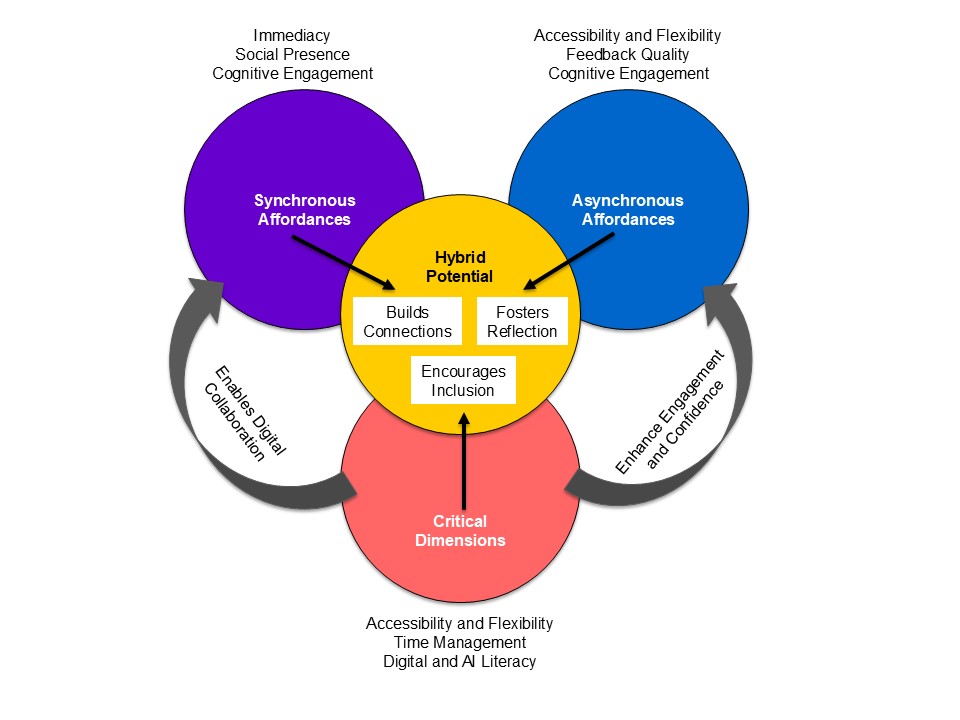
To bring these findings together, we developed a hybrid model that illustrates how synchronous and asynchronous approaches can complement one another. As shown in Figure 1, synchronous interactions help build connections, while asynchronous engagement creates opportunities for reflection. At the intersection of these approaches lies the potential for more inclusive and meaningful collaboration.
However, simply combining live meetings and asynchronous activities does not automatically make a writing group more inclusive or effective. A hybrid approach needs thoughtful design. Participants need to understand how the different activities connect, when and how feedback should be provided, and what is expected of them. Importantly, doctoral writers should have meaningful opportunities to contribute, regardless of whether they feel more comfortable speaking during live discussions or developing their ideas through written feedback.
Why does the design of doctoral writing groups matter?
Our review draws on the Community of Inquiry framework, which highlights three interconnected dimensions of meaningful learning: social, cognitive, and teaching presence. In doctoral writing groups, social presence involves developing relationships, trust, and a sense of belonging. Cognitive presence concerns engaging critically with ideas, feedback, and writing. Teaching presence relates to how learning activities are designed, organised, and facilitated. These dimensions help explain why access to digital tools alone is insufficient.
A writing group may have excellent digital platforms but still struggle if participants feel disconnected, feedback lacks depth, or expectations are unclear. The role of the facilitator is therefore particularly important. Facilitators can support meaningful engagement by establishing clear expectations, structuring feedback activities, encouraging contributions from different members, and helping participants connect their synchronous and asynchronous experiences.
Digital and AI literacy also deserve attention. Doctoral writers increasingly encounter digital platforms and AI-supported feedback in their writing practices. However, the ability to use these tools effectively and critically cannot be assumed. Our review identifies AI literacy as an emerging area requiring further research, particularly regarding ethical use, equitable access and writers’ agency. These considerations suggest that designing effective writing groups involves more than deciding which platform to use. It requires attention to how different participants experience collaboration and what support they need to engage meaningfully.
Towards more inclusive doctoral writing communities
Doctoral writing is not simply about producing text. It also involves developing ideas, responding to critique, building confidence, and learning how to participate in scholarly communities. Our review highlights how the ways doctoral writers interact online can influence these experiences. Real-time meetings can strengthen relationships and support immediate feedback, but they may also create pressures that limit participation. Asynchronous formats can provide flexibility and space for reflection, but they can make it harder to sustain momentum and connection.
A thoughtfully designed hybrid approach offers opportunities to bring these strengths together while addressing their limitations. The important question, then, may not be whether synchronous or asynchronous writing groups are better. Instead, we need to ask how we can design writing groups that allow doctoral students with different circumstances, experiences, and preferences to participate, contribute, and learn together. Ultimately, meaningful collaboration is not determined by whether doctoral writers occupy the same physical or digital space at the same time. It develops through the opportunities they have to exchange ideas, reflect on feedback, build relationships, and contribute to shared knowledge.
Questions to ponder
- How do the ways we organise doctoral writing groups influence who feels comfortable contributing and whose voices are heard?
- Do synchronous writing sessions always encourage meaningful collaboration, or can the expectation to respond immediately sometimes limit participation?
- How might we combine real-time discussion and asynchronous feedback to better support doctoral writers with different needs and circumstances?
- What role should facilitators play in creating inclusive, supportive and sustainable doctoral writing communities?
